quarta-feira, 9 de julho de 2014

not so sad in brasil

there's this idea circulating in the states that everybody in brasil spent yesterday crying.  this implies that the power of soccer to bring people together has wiped out popular opposition to the cup, that it was the magic of the game - rather than the tear gas, live ammunition, and arbitrary arrests - keeping people away from protests, and that yesterday, the entire country looked more or less like the pictures on the sadbrazilians tumblr (which, incidentally, was also a huge hit here).


só que não,  which is to say, not so much.  plenty of people were hoping brasil would stay alive in the cup long enough to be humiliated by argentina in the final, especially after the interview in which rio's mayor, eduardo paes, told the guardian that he'd kill himself if this happened.  but there are a lot of folks who loved seeing the brasilian team go down so absolutely and embarrassingly.  there's still plenty of cup left to go - major protests are scheduled for the final game, which may have much larger turnout now that brasil's out of the cup - and depending on today's semi-final game, brasil could still lose to argentina in the consolation round for third place.

i'll write more about this as it unfolds, but in the meantime, here's what my facebook wall looked like in yesterday:

before the game, neymar's recent injury, and the nation-wide trauma it was about to evoke, was compared to the police brutality which even the mainstream media hasn't ignored recently:


as well as the overpass in belo horizonte - the city that hosted the germany-brasil semi-final - that collapsed last week, killing 2 people and injuring at least thirty:


in light of neymar's injury, facebook was full of reminders of the 1962 cup.  when pelé was injured that year, he was substituted by a player named amarildo, who helped lead brasil to a victory.  last year, "pacifying" police in rocinha, rio's largest favela, tortured and [presumably] killed amarildo de souza local 47-year-old construction worker and father of four.  his body still hasn't been found, but people have been pointing out that amarildo can't save brasil this time around.

during the game, people joked about germany's uniforms, which were inspired by flamengo, the most popular team in rio.  the idea of flamengo beating the shit out of the national team was huge, as were the messages reminding us of all the workers' movements that have been clamped down on before and during the cup.  as the score crept up, someone posted:  "going on strike is a right for all workers.  ALL OF OUR SUPPORT GOES TO THE BRAZILIAN NATIONAL TEAM'S STRIKE!"

after the game, facbeook was full of reminders that investing heavily in soccer instead of more pressing social needs looked especially stupid after a loss in the semi-finals.

today we learned that germany, aside from having schools and hospitals, can also score goals.
see you later, folks.

...and full of digs at ronaldo, former cup star and current bloviating airhead who told the press last year that a world cup victory was worth prioritizing stadiums over hospitals:


it really would have been better
to have built hospitals

meanwhile, the attitude of inevitable victory was summed up by one unfortunate tattoo:

sixth-time champion 2014

and amid all the comparisons of national character, there was this:

- god is brasilian
- god is dead
finally, this poem was written in 1978 and has been popping up on facebook for at least a year, but it had a major resurgence last night.


is the cup over? it's no big deal.
farewell to kicks and systems.
now we can finally
take care of our problems.

there wasn't enough point inflation?
real inflation continues.
we'll stop being so foolish
if we kick at the right target.

in another tournament, the people,
if they're tenacious, 
will win a strong and full victory,
in the freedom cup.

- carlos drummond de andrade


brasil's cup dreams are over, but the protests it spawned are not.  stay tuned...


quarta-feira, 25 de junho de 2014

“the party in the stadium isn’t worth the tears in the favela:” world cup protests, day 12

on monday, the favela came down the hill.  this is both immediately newsworthy and not at all new: the idea of favela residents leaving their communities (many of which are located on hillsides) and heading down to the city streets en masse to engage or defy the middle-class norms of life in the “asphalt” has been generating headlines and clichés in rio de janeiro for at least a century.  it’s been used to describe everything from the spread of samba’s popularity in the 1920s and 30s to shows of force by drug cartels in the early 2000s to the daily commutes of the maids, office workers, and the growing numbers of teachers, lawyers, and doctors who live in the favelas.  it’s also pretty much the de rigueur image associated with favela-related protests, which more often than not address the state-sanctioned violence that’s been disproportionately directed at favela residents for at least the past century (usually through police or army actions, although historically there have been several of instances of arson and other semi-official strategies to displace or “tame” favela residents).

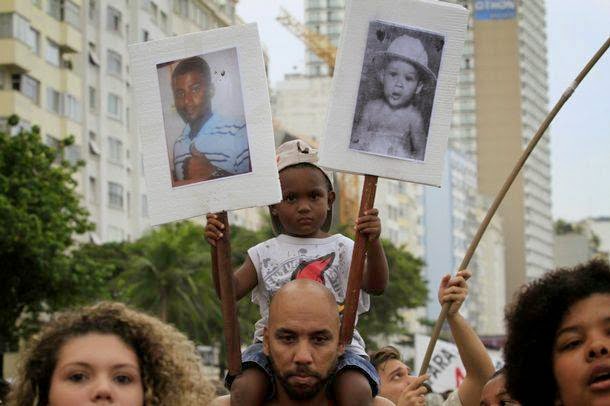
pictures of favela kids killed by police violence.  photo by gas pa hampton
monday’s march was no exception: as we walked along the beach at copacabana, heading from chapeu mangueira to pavão/pavãozinho and cantagalo (all “pacified” favelas), one of the main chants was “ih, fudeu!  a favela desceu” (very roughly, “oooh, you’re fucked!  the favela came down!”)  the chant both mocks and plays into the common fear of favelas as lawless, violent places eternally on the verge of descending to upend the rest of the city, shutting down businesses and enforcing a reign of terror through small armies of coked-up adolescents with machine guns.  in this case, though, the “hills” came down to the “asphalt” with giant banners and photos of some of the hundreds of favela residents killed or disappeared by rio’s police in recent years.  (if you imagine that rio’s cops don’t enforce their own reign of terror – especially in the city’s favelas – you haven’t lived here long enough to get questioned and searched at gunpoint by a coked-up post-adolescent with an ar-15 and a uniform).

the march, called “a festa nos estádios não vale as lágrimas na favela” (the party in the stadium isn’t worth the tears in the favela), was sponsored by a coalition of social movements from favelas throughout the city.  it began monday morning in chapeu mangueira with hip-hop, poetry, and capoeira presentations before heading down to copacabana, where tens of thousands of soccer fans in face paint and green-and-yellow shirts (both locals and tourists trying to soak up brazil’s world cup vibe) were waiting for the start of brazil’s final preliminary game against cameroon, and where a massive, mostly foreign, press corps was waiting to capture anything out of the ordinary.

it wasn’t an especially big march, but there were more people there than at recent protests (around 300 when i reached it near the beginning of the beach, and over 500 after another activist coalition joined us about halfway through), and the glut of tourists and photographers with press credentials helped keep the police fairly benign. we were surrounded by cordons of riot cops that grew as we made our way down the beach, and an imposing line of them blocked our initial approach toward the entrance of pavão/pavãozinho, but they didn’t let off any tear gas or stun grenades, even when the march changed course to reach pavão/pavãozinho down a series of side streets.  the protest finished without the ass kicking that’s become customary, although cops did rough up and arrest "spiderman", a well-known local activist, apparently for carrying an unfurled banner on a public sidewalk after the protest ended. 

controlling and “taming” favelas has long been the holy grail of governance in rio de janeiro.  in part, that’s because of what a major force favelas are in the city: somewhere between 15 – 30% of the population lives in them, depending in largely on what any given researcher considers to a favela to be.  the most recent initiative to bring favelas in line has been “pacification,” which is a pretty major misnomer for armed occupations by police and army forces.  i’m not much for statistics, but a local paper showed that the number of favela residents killed and disappeared by police – which has always been outrageously high – has increased in “pacified” favelas.  the cases of amarildo de souza and cláudia ferreira silva, which i’ve mentioned before on this blog, are recent examples of police killings that have gotten the most media attention for their sheer heinousness.  two weeks ago, cops kidnapped a teenager and killed him execution-style after picking him and a friend up for an alleged robbery (the friend, who they shot in his legs and back, played dead and later managed to escape).  

missing amarildo at the world cup
the current regime of pacification and the violence associated with it is specifically intended to make the city tourist-friendly enough to host megaevents like the olympics and the world cup.  that’s not to say, though, that if the world cup were to miraculously leave us alone tomorrow, the favelas would return to being peaceful urban utopias.  they never have been, and the very real link between recent police killings and the world cup shouldn’t overshadow the fact that these communities have always suffered the brunt of the city’s officially-approved repression and brutality. the contrast between the party in the stadium and the tears in the favela is not just a question of emotional opposites; it’s also a question of time and permanence.  this stupid cup will end on july 13 – exactly 365 days after amarildo was disappeared – but the favelas’ tears will undoubtedly continue.  in coming months, the powers that be will start to steamroll into preparation for the olympics, and local real estate developers who are also major political contributors are already eyeing beachfront favelas as prime targets for the next big deals.  (david beckham recently bought a mansion for 1 million reais – a little under us $500,000 – in vidigal, on the other side of the hill from the where amarildo was disappeared, and currently under the command of the same “pacifying” police unit).


i’m not at all an expert on favelas or on the daily experiences of people who live there:  at most, i’ve visited friends’ houses, or gone to concerts or dance parties or protests.  i’ve seen firsthand a few of the changes that have led up to the world cup, like the large-scale destruction of houses in providência and manguinhos, but i’ve missed the worst, like the massacre in maré on june 24, 2013.  still, i’ve been in rio long enough and seen enough to know that, although the world cup is by no means the sole cause of violence or excuse for police violence in the favelas, both fifa’s demands and local government’s desire for a city prepared to host the cup has undoubtedly led to a significant increase in the violence to which favela residents are so frequently subjected.  monday’s protest highlighted their resilience, and their resolution to speak out and to stand for themselves in a city where the fleeting presence of the international press keeps them much safer than the presence of the local police ever has.

photo by gizele martins

quinta-feira, 19 de junho de 2014

this is not what democracy looks like: world cup protests, day 6

five close friends of mine were arrested at a protest on tuesday night in downtown rio, apparently becomes they were wearing facepaint and carrying empty paint cans to use as percussion instruments.  they were in the streets with the latest installment of an ongoing performance/protest that many of us have been working on for the past three years.  they had already been frisked twice at police checkpoints on their way to the protest, and cleared to go ahead both times, but within ten minutes of arriving outside candelária church, they were surrounded by a squad of riot cops, marched away from the protest, jammed together into the backseat of a sedan, and driven to a police station in the north zone, thirty minutes further up the highway (despite the plethora of police stations around rio’s downtown).  they weren’t charged with anything, but they were photographed for a registry of “people directly or indirectly involved in protests”and questioned without being allowed to speak to a lawyer present (in obvious violation of their basic rights).  more to the point, they were taken off the street for the night (they were released after about 3 hours), and warned ominously that there would be trouble if they were picked up again at any protests in the future.

confiscated cans at tuesday's protest.  photo by comitê popular rio copa e olimpiadas.
being slathered in paint and banging cans are not usually arrestable offenses in rio de janeiro, especially on empty downtown streets. actually, being slathered in paint and making too much noise seem to be hallmarks of the soccer fan experience, especially at world cup.  my friends were arrested at a march that had at most 50 other protestors and at least 200 cops, about 3.5 miles away from maracaña stadium.  during the abbreviated protest, no property was damaged, no businesses were disrupted (nothing was open downtown), and the only people on the street were drink vendors and a few facepainted, air horn-honking fans watching the game at kiosks and pushcarts.  still, cops managed to arrest at least 15 of the protestors, including all of the passengers who boarded a bus through the back door after cops insisted that the driver open it.

the cops’ conduct was arrogant, authoritarian, and also just plain stupid:  if they had just let the protestors march, entirely surrounded by several columns of police, the mainstream media would have ignored the protest or laughed it off, and everyone would have been able to go home sooner.  but individually and as an organization, the police here want to crush any and all dissidence.  in this sense, the arbitrary arrests go with the gun-waving and warning shots we saw on sunday night near maracanã:  they’re meant to scare protestors off of the street.  and it seems to be working (although it’s worth pointing out that calling a protest for downtown an hour after the brasilian team’s game began was a major scheduling fuck up).

i’ve written about police brutality before on this blog, and true to form, there were plenty of other police actions throughout brasil in recent days that completely overshadow the arbitrariness of my friends’ and other protestors’ arrests. in cidade de deus, a “pacified” favela, cops shot and killed an unarmed 13-year-old on sunday (officially he was killed in a shoot out, and no responsibility has been assigned yet, but this usually signals police culpability).  this happened again in manguinhos, another "pacified" favela, on wednesday night, this time with a 25-year-old victim.  meanwhile, in recife, in northeastern brasil, military police wounded dozens of young people occupying land at the center of a development debate.
 
comparatively, my friends had it easy:  five costumed performers getting picked up by cops is not nearly as worrying as young people getting killed, and watching high armored robocops squint carefully into paint cans in a desperate effort to invent some sort of criminal intent was at least as funny as it was infuriating.  our network of friends operated quickly enough so that there public interest lawyers waiting for them by the time they got to the police station, and 10 more of us – mostly in costume, or covered with tattoos, or both – came to support them, pass around snacks, and wait for their release.  a combination of all this attention, the fact that all of my friends are college graduates, and the flimsy logic that riot cops gave the station police to justify the arrest (that my friends’ facepaint and the single bandana among them qualified as hiding their identities, and that the paint cans they were drumming on were actually intended as projectiles) meant that the police went easy on them:  apart from the illegal interrogation, the illegal photo registry (which is apparently part of an international database), and a constant stream of harassing and provocative questions, they came and went without major problems. but the fact that the rights to free expression and free assembly, both guaranteed by brasil’s constitution, are being actively and meticulously undermined in the hopes that everyone will shut up and get back to watching the games isn’t just annoying and intimidating from where we stand:  like so much about this world cup, it ought to be alarming to anyone who cares about basic human rights.

being censored is obviously not the same as being tortured or killed, but suppression and violence go hand in hand:  both are vital to creating an atmosphere of obedience based on fear.  and policing based on personal tastes, criminalizing anything that looks wrong, is a guarantee for continued brutality in the future.  the cops who decide that costumes and paint can drums don’t belong on an empty street are relying on the same sort of logic that justifies killing young people of color in favelas.  it’s all uniformed vigilantism based on appearance, and in rio de janeiro - and throughout brasil - it seems to be getting worse.

i got news of my friends’ arrest on tuesday as i was arriving at the protest, and i stopped on a street corner to trade phone numbers with mutual friends in order to get more of us to the police station as quickly as possible. as soon as i’d said hello, a middle-aged guy with big arms and a yellow-and-green t-shirt approached me, yelling for me to move on before he beat the shit out of me.  i explained that i was on a public sidewalk, and he yelled back that he didn’t like me, that my friends and i deserved to die, and that i should get the fuck away.  (i assume this had to do with my fabulous protest outfit, which involved glitter and a raggedy red dress).  30 cops approached us, sensing a possible fight, but they weren’t about to keep the peace; they only came to shout at me and egg him on.  i got the fuck away.  (at sunday night’s protests, cops stood by calmly while local bar patrons in the vila isabel neighborhood beat two protestors bloody).


so:  i’m sorry to sound like a broken record, but as i’ve been writing for a while, this world cup is a travesty for human rights.  as you watch the games, some of us in brasil are being silenced in the name of order and good sportsmanship, and others are being beaten up or killed in the name of progress, “pacification,” and public safety.  as we welcome the world to celebrate, those who don’t fit into the idea of what a “country without poverty” (part of the federal government’s official motto) is supposed to look like are being subject to policing that recalls the military dictatorship of the 60s and 70s.  this may be what a world cup demands, but it’s not what democracy looks like.

photo by comitê popular rio copa e olimpiadas.